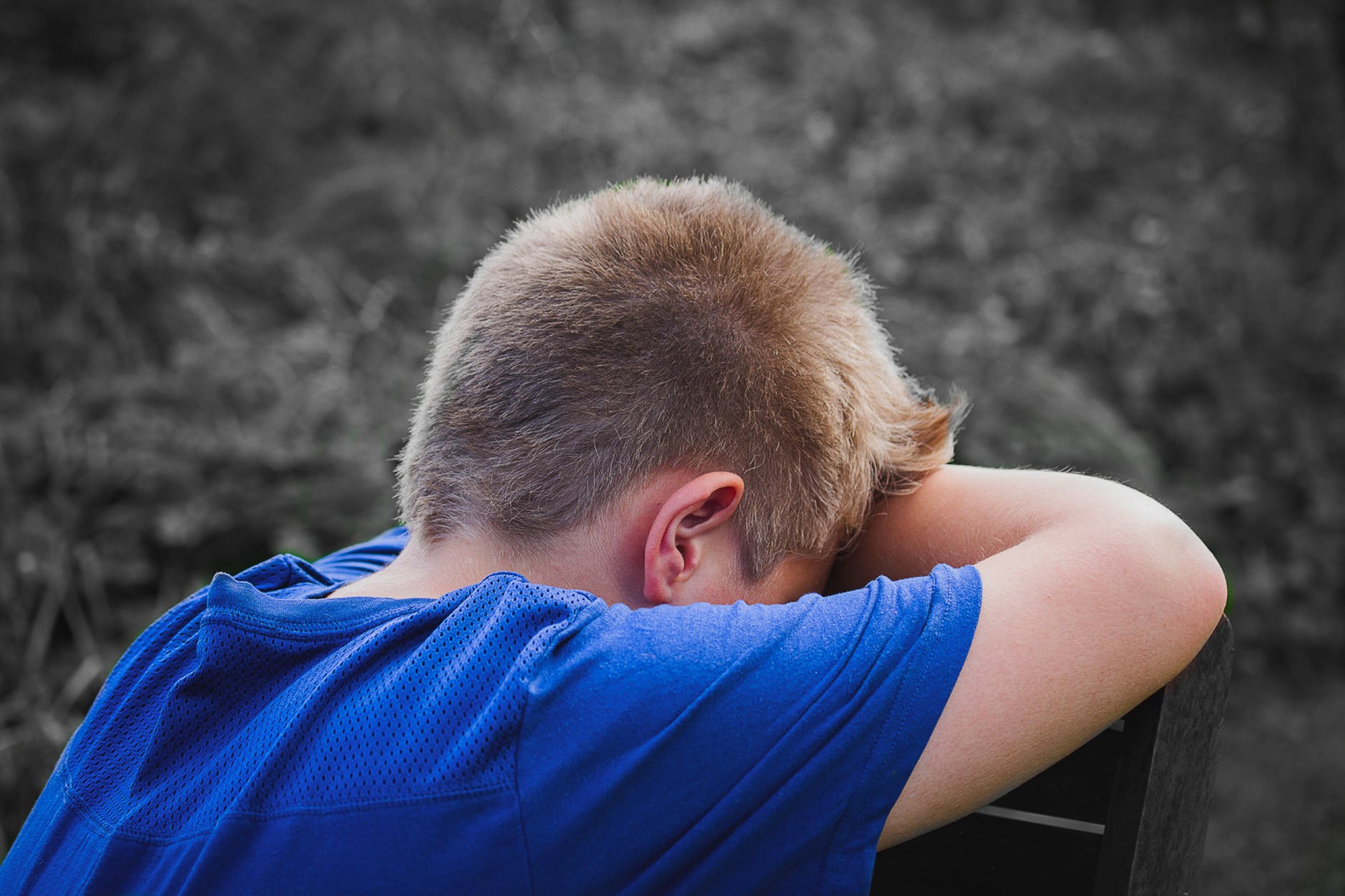
Tears streamed down my face as I stared back at my son. It was difficult to watch tears also fall down his precious, still-not-quite-yet-grown-into-a-teenager 13-year-old baby face. My heart hurt as I silently prayed for wisdom.
The pain of what he had just told me still lingered in the air.
We were supposed to have left for Office Depot two hours ago, but it didn’t happen. Instead, seconds before walking out the door, my son took to his most obvious form of telling me that he needed to talk (being disrespectful).
If there is no other sign that your kid really needs someone to listen to what they have to say, it’s the moment they get defensive and disrespectful.
I’m learning to put everything else on the back burner when I can tell that my son has something he NEEDS to say.
Which also means Office Depot goes out the door and we don’t. It also has meant being late for school a few times last year (that lady you saw standing in the parking lot at school with her kid 40 minutes past- that was us; working things out); sometimes it means being late to important events, or not coming at all. Whatever it is, I’m learning to let the world around me stop so that I can hear what my son is really trying to say.
After the two hours of talking in circles, my son was finally able to tell me that he was angry that I had forgotten about the fact that he had told me his legs had been hurting him, and that I still had continued to ask him to get up off the couch and hurry to get his shoes on so we could leave.
It was somewhere between an “AH HA!” moment, and Homer Simpson’s “DOH!” moments.
I had completely spaced that I had just picked up my son from an all-day basketball clinic and that the coach had made them do work-outs that he wasn’t used to. I finally remembered him slumping into the house from the car like a one-legged chicken.
He struggled for two hours to tell me that he was angry that I seemed to be ignoring the pain he was in.
I apologized for forgetting about my son’s pain, but also took a moment to remind him that he could have told me that he was still in pain or that he could have told me to give him a minute to let him get his legs moving again before going out the door. Either way, it would have avoided the problem we were currently having.
My son nodded bleakly.
“Did we learn anything from this moment, Baby?” I asked.
Baby Boy sighed, hemmed and hawed. “Umm…”
I was starting to feel frustrated. Was he even listening?
“Do you think next time you can tell me when you’re hurting so we can avoid this problem?”
I looked Baby Boy over. He looked almost despondent as the tears now flowed down his face.
“What’s wrong, Baby?” I asked.
“I’m sorry I was rude,” he said, solemnly, but still with a bleak look on his face.
My Mom-antennas were working in full-force trying to figure out what was going on inside my son. I could see Baby Boy was hurting, but I wasn’t sure how or why. “Baby, what is wrong?”
“I’m afraid….” Baby Boy blurted out.
My blood went cold.
My Baby Boy.
Afraid?
Of WHAT?
For as long as we’d had him, he’d never really said that he was afraid of anything.
More tears poured down his face.
“Just tell me, Baby. Just say it.”
“I’m afraid that if I’m a bad kid, you won’t want to be around me any more! That you’ll just see me as some problem, delinquent child- and you won’t want to be around me any more!”
And there it was.
Every adopted child’s worst fear. Probably every child’s worst fear. I remember having this fear even in coming from a loving family.
I felt fortunate enough that my son had the words to even go there; to even say it. Most kids don’t.
I wanted to say SO much to him. More than anything, because it was as far from the truth as it could possibly be. My son is my JOY. Not want to be around him? I couldn’t even fathom.
But my son could easily fathom. Why? Everyone else in his young life “didn’t want to be around him.” He was passed from person to person to person. Like an object.
Like a problem.
A problem that when it got to be “too much,” for one person, “the problem” was passed on to someone else.
I could see the anguish on his face. I prayed that the next words I said would words of life, instead of words death.
“Baby Boy, hear me when I say this: YOU, my Son, are NOT a PROBLEM.”
“Yes I am! I’m just a big problem!” My son sobbed.
“Baby Boy, I want you to understand something: no matter how bad you are, no matter how rude or disrespectful or ‘delinquent’ you could possibly be… you will NEVER be a problem. There is no problem you will ever HAVE that would make us not want you. You can be good, or bad, disrespectful or rude, or do the worse things in the world, but what you do does not change how we feel about you.
“I don’t ever look at your bad moments and think, ‘Oh no, another problem to deal with.’ It doesn’t even cross my mind! When you have bad moments, I look at you, and I think, ‘How can I help my son see the truth? How can I have my son have right, healthy thinking? How can I help my son THROUGH this problem he’s dealing with?’ When I look at you, I don’t see a problem! I see a person! A person whose life I love being a part of. YOU ARE MY JOY. Good or bad, you will always be my JOY because you are YOU. There is nothing you could ever do to change that. Don’t you ever forget that you are a PERSON; NEVER a PROBLEM.”
We looked at each other with tears streaming down both of our faces. I could see the weight of the world had lifted off my son’s shoulders. He reached his hand out to mine and held my hand. “Thanks, Mom.”
I had to look through my son’s eyes to realize that though a person may HAVE problems, a person is NEVER “a problem.”
A person is always a person.
Never. A. Problem.
The next day as I drove down the road, I passed homeless camp after homeless camp on my route to work. Garbage and filth over flowered in the area. I looked over at the man standing at the stop light with a sign that read, “Please help.” He had always been there, for as long as I could remember, he’d been there.
But for the first time, I didn’t see a problem. I. Saw. A. Person.
 Author Anne Day